Saturday, September 30, 2017

Some Nepali Jokes (And Why They're Funny)

Nepali humor is usually quite goofy in nature. Although I have noticed some instances of sarcasm and dry humor, this is definitely the exception, not the rule.
When I was first learning Nepali I talked with a nice lady who enthusiastically told me a Nepali joke. Although I didn't understand everything at that time, I got the gist of it. It basically went like this:

Saturday, September 23, 2017

हुनु Hunu - "To Be" in Nepali

Hunu is a very interesting Nepali verb. It means "to be" - simple enough. But it changes form depending on what you are talking about, so you have to get multiple conjugations of this verb straight.

Much like Spanish, there are two different forms to use when saying "to be" in Nepali. In Spanish, you have ser and estar.
In Nepali, though, it's really just one verb (हुनु hunu) which is changed depending on the way you are using it - to define or to describe.


Friday, September 22, 2017

Nepali Verbs - Conjugation in all forms/tenses (Part 1)

For the sake of simplicity, in the examples of verb conjugation, we will mostly use the verb गर्नु garnu, "to do"
There are a couple of irregular verbs in Nepali to keep in mind as well. However, most of the verbs will follow these rules.

Nepali has different levels of politeness/respect, and with each level there is a corresponding verb conjugation. It's difficult to keep track of them all at first, so if you like you can just focus on the most polite forms to make it easier on yourself!

To begin with...

All Nepali verbs end with -नु  -nu.
To conjugate the verb into a different tense, you have to remove the -nu ending to leave the "stem" of the verb. In the case of गर्नु garnu, the stem would be गर् "gar." Then you can change the ending depending on the conjugation needed.

Monday, September 11, 2017

Beginner Nepali Video Lesson 1 - Meeting Someone New


Have a look at our latest video on our YouTube channel!

This time Sharad is here to teach you a few basic phrases to introduce yourself in Nepali.

Please like and subscribe on our channel to see more like this in the future!

Thursday, September 7, 2017

Best Resources For Learning Nepali

I've searched for/used nearly every medium available for learning the Nepali language. Now that I'm fluent, I can share my tips about which resources helped the most! Here are some of them...

  • Hamro Dictionary

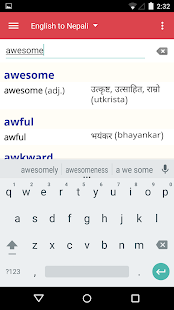
This offline dictionary is available for free on the Google Play store. It's a pretty comprehensive dictionary considering it is a mobile app and is helpful for when you're out and about - you don't have to lug a huge dictionary around with you like I used to when I first started learning Nepali!
There are some typos and words that I've searched for that aren't in the dictionary. But overall this is a great resource.
Be sure to check out the developer's other apps as well. Their app Hamro Patro has a lot of tools to use on your trip to Nepal, from currency conversion rates to Nepali festival dates and everything in between.


*

  • NEPALI IN CONTEXT: A Topical Approach to Learning Nepali

This is rare (and expensive) to find online...Amazon currently lists it at $55USD!
But it can be found in Nepal at larger bookstores and it contains a wealth of information about Nepali grammar, vocab, phrases, etc. All presented in an easy-to-understand manner.
The book is designed to be best used with a Nepali tutor, so if you have a Nepali friend to practice with, that would be the best approach.


  • Nepali Movies on Youtube


The Nepali film industry doesn't care much about pirating movies - for the most part, the film companies themselves release films for free on YouTube a few months after their initial release in theaters.
This provides a wealth of options for Nepali entertainment/listening practice.
Nepali films are great for two reasons - one, you can listen to Nepali people speak naturally (read: extremely fast and difficult to understand) and two, Nepali movies are just absolutely bonkers.
In recent times Nepali movies have taken a big step forward in terms of not being so very corny, but there's plenty of goofy, contrived fare to enjoy.
Some more recent uploads include English subtitles, but it's also fun and good practice to figure out what's going on watching without subs.
Just search 'Nepali movie' on YouTube and a lot of choices will show right up.


  • English learning textbooks found at Nepali stationery/book shops

It may seem counter-intuitive to pick up a book in Nepali about learning English, instead of the other way around. And the English is often phrased a little oddly...
But these are a very cheap, easy to use resource for learning Nepali. Many of these books are put together for Nepali students looking to get a working visa abroad. So the phrases/grammar given is simple, everyday conversations covering introducing yourself, small talk, asking for help in an emergency, etc.
The reason these are great is that while the English translations may be a little stilted, the corresponding Nepali phrases are accurate. It's great reading practice after you've learned the Nepali alphabet and it will help you understand the grammar of basic Nepali sentence structure as well. There's usually a concise dictionary of important words at the end as well.
Best of all, these books are usually only a couple hundred rupees (2 or 3 U.S. dollars), so it can't hurt to pick one or two up when you arrive in Nepal.


Mero Maya Nepal Episode 2 - Boudhanath

Check out our new video about Boudhanath, an enormous Buddhist stupa on the east side of Kathmandu.

Boudhanath stupa has been around for centuries and is a hub for Tibetan culture in Nepal. You can find souvenirs, traditional clothing, and food from multiple Nepali cultural groups.
Many tourist attractions in Kathmandu are tied to Hinduism and shopping around these areas is more akin to south Asian clothing and souvenirs. But Boudhanath has more central Asian vibes and is an interesting change of pace.

Not mentioned in the video, but there is very good food to be found around Boudhanath as well - from traditional Chinese food to enormous momo (steamed dumplings) to Himalayan Java (Nepal's equivalent to Starbucks).

It's an extremely popular tourist destination as well as a UNESCO World Heritage Site. Definitely worth checking out during a visit to Nepal.

Sunday, September 3, 2017

5 Things You Might Not Expect in Nepal

Here are a few things that you might be surprised by on your first visit to Nepal:

1. Dogs


Dogs are EVERYWHERE in Nepal. In Kathmandu especially, you will find dogs on basically every street. Some are dogs with a home who are allowed to roam where they please, others (most of them) are street dogs.
If you are afraid of dogs, this might be a challenge for you, but for the most part dogs are happy to leave you alone. I am a dog lover so I approach most dogs that seem friendly and 90% of them are just happy-go-lucky, friendly individuals. But you do have to be careful! Some dogs can be vicious, especially near butcher shops where they are intent on getting scraps of meat (and competing with other dogs for it). At night some friendly dogs turn into guard dogs as they try to keep strangers away from their territory, so be careful if you are walking late at night. Also the adage that dogs can smell fear is really true as far as I'm concerned - a friend of mine who is afraid of strange dogs and never approaches them has had more run-ins with less-than-friendly doggies than I have, and I basically throw caution to the wind when it comes to meeting dogs. So just be prepared for lots and lots of pups.
And one more thing - if you feed a dog in Kathmandu, that dog is automatically your forever friend and will follow you EVERYWHERE. Once I had a dog follow me down several blocks of a busy part of town, risking the ire of other doggie gangs. I felt bad for him as he tried to escape getting in a scrape just because he wanted to be with me. So keep that in mind if you are into making dog friends.


2. Cows

While not as common as dogs, cows are a very common sight. Since cows are sacred in the Hindu religion, cows are generally used for milk, but are very rarely slaughtered and used for meat. While this sounds like a good thing for cows, there are some problems attached. Most people will keep a baby girl cow because she will grow up to be a milk maker, but baby boys are considered worthless except for breeding. So if someone already has a bull for breeding, they just leave the bulls out on the street to fend for themselves.
Because of this, there are baby bulls in places where you shouldn't find them - their favorite place to hang out is smack in the middle of busy roads where the blacktop is nice and warm from the sun. If they are wandering around shops and sidewalks people tend to chase them away, and they are usually very skittish. It's a very sad thing to see and I wish I had a big farm to keep all the baby cows in!
Occasionally you will see a big truck go down and collect all the stray baby bulls they can. I'm not quite sure what they do with them though...

3. Littering

There is trash everywhere in Kathmandu. People don't think twice about littering wherever they are. Public trash cans are usually nowhere to be seen, so that may be an explanation. The first time I came to Nepal, the trash collectors went on strike, and you had to wade through a SEA of garbage. Fortunately that hasn't happened for a while, so there's just a "normal" about of litter scattered about.
Sadly many rivers and bodies of water in Kathmandu are disgusting and smelly now because of poor waste and trash management. Friends of mine report that just a few years ago they were much cleaner.
BUT if you are looking for natural beauty in Nepal, it is everywhere - just not in Kathmandu. And you don't have to travel all the way out to the Himalayas to find it. Go out a few miles in any direction and you will find beautiful scenery and clean rivers/streams. Of course, the best sites ARE in the trekking areas of Nepal outside of Pokhara. When I went trekking on the ABC route (Annapurna Base Camp), the views were gorgeous. There was no trash to be seen and the streams coming from the mountains were so clear and clean that I could drink it without getting sick (in Kathmandu I filter even the "drinking water" so that should tell you something)!


4. What's going on with the power lines?!


Take a trip to Thamel - the busiest part of Kathmandu and a big tourist hub - and you might notice something odd right away - the power lines are just a huge tangled mess. I don't know how electricians can keep track of it all, but they seem to have a handle on it. It looks like a fire hazard but I've never seen an accident happen...yet....
And as for loadshedding (scheduled power outages) - that thankfully is not as big of a problem in Kathmandu as it was a year or two ago, but power outages that AREN'T scheduled are still common. Most places (restaurants/hotels/etc.) have a generator or at least a battery-powered line so that you can still use lights and charge your phone while the main power is out.

5. Queuing is a free-for-all

Nepali people, for the most part, don't believe in "standing in line" like you may be used to.
If you go to a bank or an office people will usually abide by the rules, but in a more informal setting (e.g., shopping at a busy store) people are more than happy to literally push you aside to get in front of you. Be ready for that. Pushing is one of my very few pet peeves, so it was very hard for me to deal with at first. Don't be afraid to squish yourself as far ahead as you can in a busy crowd. People won't blink an eye. It's not really considered rude to cut in line or push ahead - it's more of a "well, you should have gone further up if you didn't want it to happen" sort of situation.

All this being said, I love Kathmandu and its many quirks. It may be dirty and noisy and crazy in every sense, but that makes it more of an adventure! The things I listed here may be viewed as "cons," but they do certainly make for a very interesting experience. So please don't be scared off by any of this. Kathmandu has so many can't-miss sites and experiences!
And as I mentioned, Kathmandu isn't the only thing Nepal has to offer. I'll be sure to include posts about other places outside of Kathmandu in the days to come.

In the meantime, check out our YouTube channel - Mero Maya Nepal. We're working on adding video tours of different attractions in Kathmandu and other places in Nepal.

Rahecha रहेछ Part 2 -- Nepali Verb Endings

 In a previous post , I went over the Nepali word "rahecha" रहेछ which indicates the speaker is surprised about something or just ...